Access to books should not depend on location, income, or physical access to a library, however for many people around the world, it still does.
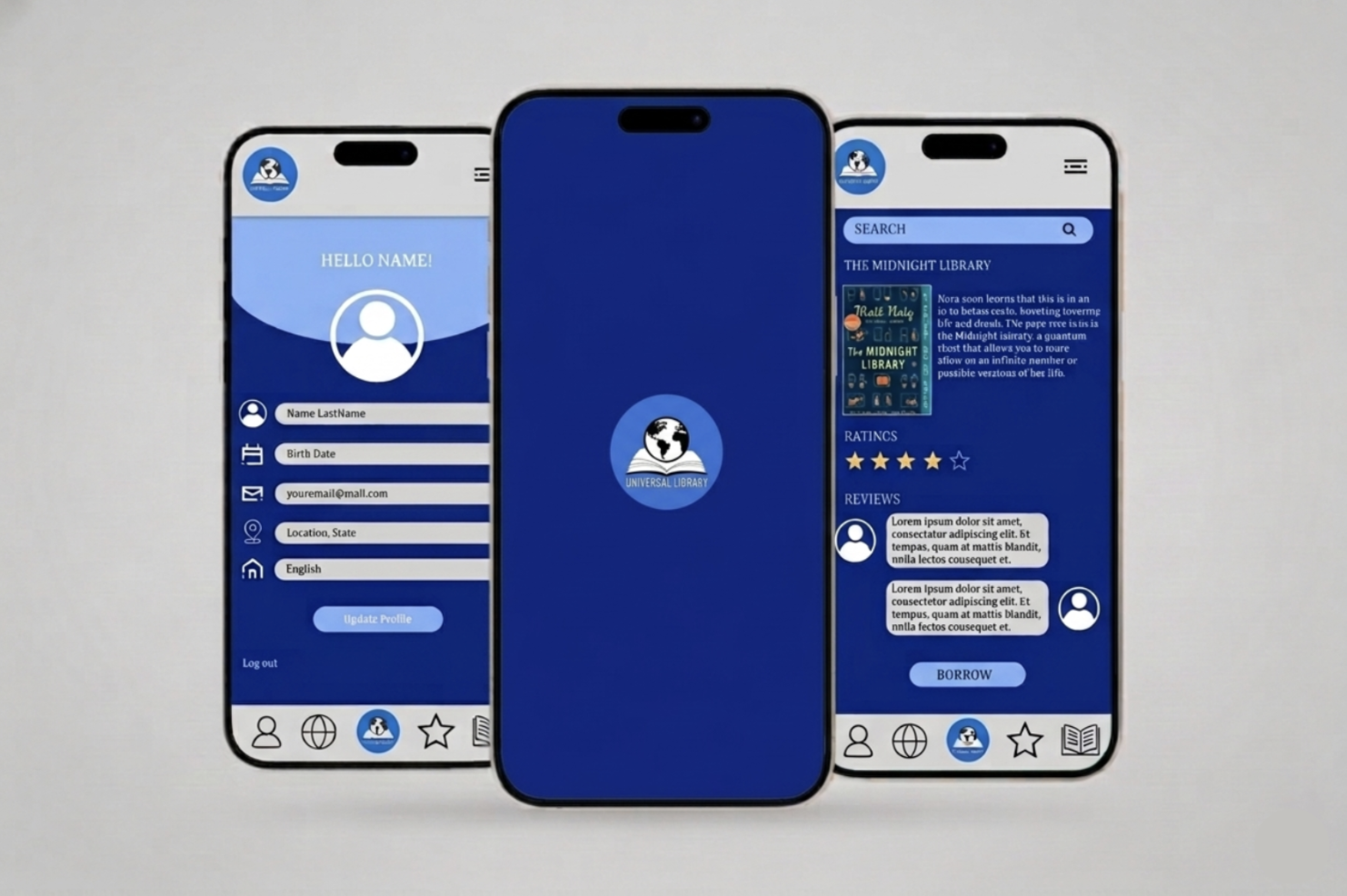
This project is a prototype for a mobile application that explores the design of Universal Library, a software that reimagines what a library can be in a digital, global context. The idea is simple: create a platform where anyone, anywhere, can access a shared collection of books without needing a physical library card.
The prototype was developed using Figma and focuses on creating an intuitive, accessible, and inclusive reading experience. It combines core library functions such as searching, borrowing, and reading with modern features like social interaction and multi-device access, which will allow the user to not only read on their phone, but also on a Kindle, iPad or any other mobile device, and multilingual support, allowing uploads of books in any language.
Despite the growth of digital content, access to books remains uneven, since traditional libraries are limited by geographic boundaries, limited physical inventory and access restrictions tied to residency or membership.
At the same time, existing digital reading platforms often require paid subscriptions or purchases, lack global accessibility, provide limited multilingual options, and focus more on consumption than community.
This creates a gap for users who want free, reliable, and inclusive access to books, especially across different countries and languages.
The challenge was to design a platform that removes these barriers while still feeling simple, secure, and user-friendly.
Universal Library is designed as a free, global, mobile-first digital library that allows users to browse, borrow, and read books entirely online.
Users begin by creating an account, which generates a digital library card that allows them to search and browse a multilingual catalog, borrow or place holds on titles, read directly within the app or across devices, track reading progress, leave ratings and reviews, and connect with other readers.
The experience is intentionally designed to feel clear and intuitive, with a focus on simplicity and accessibility.
The app also introduces flexibility, including offline reading and privacy controls.
My role focused on translating a complex idea into a usable mobile experience.
I designed user flows, created an accessible interface, and structured the app for multiple user behaviors.